
What Is Invoice Price?
Invoice price is the amount listed on the invoice a car manufacturer sends to a dealer for a new vehicle. It is useful because it gives shoppers a pricing benchmark below MSRP before they compare dealer offers.
Invoice price does not always equal the dealer’s final real cost. Dealer holdback, factory-to-dealer incentives, dealer cash, volume bonuses, and other credits can reduce what the dealer effectively has in the vehicle.
Use invoice price to understand where the pricing conversation starts. Use the out-the-door price to understand what you may actually pay.
What Does Invoice Price Mean?
Invoice price is the manufacturer-to-dealer invoice amount assigned to a new vehicle. For shoppers, it is most useful as a reference point when comparing MSRP, dealer discounts, incentives, and final quotes.
The most important thing to understand is that invoice price is not automatically the same as the final selling price. A dealer may quote above invoice, at invoice, or below invoice depending on the vehicle, market demand, inventory levels, incentives, and dealership pricing strategy.
Invoice price is the amount listed on the manufacturer’s invoice to the dealer for a new vehicle. It is a strong pricing benchmark, but it should not be treated as the dealer’s guaranteed bottom-line cost.
Is Invoice Price the Same as Dealer Invoice Price?
In most car-buying conversations, invoice price and dealer invoice price mean the same thing. Both usually refer to the invoice amount assigned by the manufacturer to the dealership for a new vehicle.
The phrase “dealer invoice price” can sound more official, but the buyer takeaway is the same: it is a useful reference point below MSRP. It helps you understand the pricing range, but it does not prove the dealer’s final net cost after incentives, holdback, dealer cash, or other manufacturer programs.
Invoice Price vs MSRP vs Dealer Cost
These terms are often used together, but they answer different questions. MSRP tells you the suggested retail price. Invoice price gives you the dealer invoice benchmark. Dealer cost may be lower after credits or incentives. Out-the-door price is the final number you should compare before buying.
| Pricing Term | What It Means | How Buyers Should Use It |
|---|---|---|
| MSRP | The manufacturer’s suggested retail price, usually shown on the window sticker. | Use it as the sticker-price reference, not as the final number you should expect to pay. |
| Invoice Price | The amount listed on the manufacturer invoice sent to the dealer for a new vehicle. | Use it as a negotiation benchmark when comparing the dealer’s selling price. |
| Dealer Cost | The dealer’s possible effective cost after holdback, incentives, dealer cash, or bonuses. | Understand that it may be lower than invoice, but buyers usually cannot see the full calculation. |
| Out-the-Door Price | The final transaction number after taxes, title, registration, dealer fees, add-ons, and credits. | Use this as the final number when comparing dealer offers. |
For a deeper breakdown, read the guide to invoice price vs MSRP. To estimate the final number, use the out-the-door price calculator.
How Invoice Price Is Calculated: A Simple Example
To understand what invoice price actually represents, here is how the components typically add up for a mid-range SUV.
| Component | What It Includes | Example Amount |
|---|---|---|
| Base price | Vehicle with standard equipment for the trim | $38,500 |
| Options and packages | Factory-added features above the base trim | $2,200 |
| Destination and delivery fee | Manufacturer charge to ship vehicle to dealer | $1,295 |
| Invoice price (total) | Amount on the manufacturer's invoice to the dealer | $41,995 |
| Dealer holdback (est.) | Credit from manufacturer, typically 1–3% of MSRP | −$1,260 |
| Factory-to-dealer incentive (if applicable) | Additional manufacturer cash to the dealer, varies by model | −$750 |
| Dealer's estimated net cost | Effective cost after credits, not always visible to buyers | ~$39,985 |
Numbers are illustrative. Actual holdback and incentives vary by manufacturer, model, and region.
How Invoice Pricing Works in a Real Dealership Transaction
Invoice pricing usually does not come up naturally during a showroom conversation. Many dealerships start with the vehicle’s features, monthly payment, trade value, special offers, or MSRP. Invoice price becomes useful when you request it before you compare quotes.
If you do this, expect a more grounded negotiation. Instead of asking, “Can you do better?” you can ask how the selling price compares to invoice, whether incentives are already included, and what the final out-the-door price will be.
This does not mean every dealer will sell at invoice or below invoice. Some vehicles have limited inventory, strong demand, or fewer incentives. But invoice price gives you a better starting point than MSRP alone.
This Is Where Buyers Go Wrong
Invoice price can help you negotiate, but only if you use it correctly. The biggest mistakes happen when buyers treat invoice price as the final answer instead of one part of the pricing picture.
1. They assume invoice price is the dealer’s final cost.
Invoice price is a reference point, not a complete accounting statement. Dealer holdback, factory-to-dealer incentives, dealer cash, and sales-volume programs may lower the dealer’s effective cost.
2. They compare invoice price without checking fees.
A low selling price can become a weak deal if the final quote includes high documentation fees, mandatory add-ons, protection products, or confusing rebate treatment.
3. They negotiate payment before price.
Monthly payment can hide selling price, APR, term length, down payment, trade value, and add-ons. Start with the vehicle price and invoice benchmark, then move to payment.
How to Use Invoice Price When Buying a New Car
The goal is not to argue with the dealer. The goal is to compare numbers with enough context to know whether the offer is reasonable.
- Start with the exact vehicle. Use the same year, make, model, trim, options, and ZIP code whenever possible.
- Compare invoice price to MSRP. This shows the gap between the sticker price and the dealer invoice benchmark.
- Ask what incentives are included. A quote may include rebates, loyalty cash, conquest offers, or incentives you may not qualify for.
- Ask for the out-the-door price. This is the number that includes taxes, fees, title, registration, and add-ons.
- Compare offers using the same assumptions. Do not compare one dealer’s selling price to another dealer’s monthly payment.
If you do this, expect this
If you use invoice price properly, expect a clearer buying conversation. You may not always get a below-invoice deal, but you will be better equipped to spot inflated pricing, unclear fees, and weak offers disguised as discounts.
Used Cars Do Not Have Invoice Price in the Same Way
Invoice price mainly applies to new vehicles because it refers to the manufacturer-to-dealer invoice. Used cars are different. A dealership may acquire a used vehicle through trade-in, auction, lease return, or direct purchase.
Used-vehicle pricing depends more on market value, mileage, condition, vehicle history, reconditioning cost, and local demand. For used cars, focus on comparable listings, history reports, ownership costs, and the final out-the-door price.
Can You Buy a Car Below Invoice Price?
Sometimes, yes. A dealer may be able to sell below invoice when manufacturer incentives, dealer cash, slow-moving inventory, sales goals, or model-year changeovers make the transaction worthwhile.
That does not mean every vehicle can be bought below invoice. High-demand vehicles, limited-production models, low inventory, or strong local demand can reduce the dealer’s willingness to discount. The best approach is to use invoice price as a benchmark, then compare real offers in your market.
How to Find the Invoice Price for the Car You’re Researching
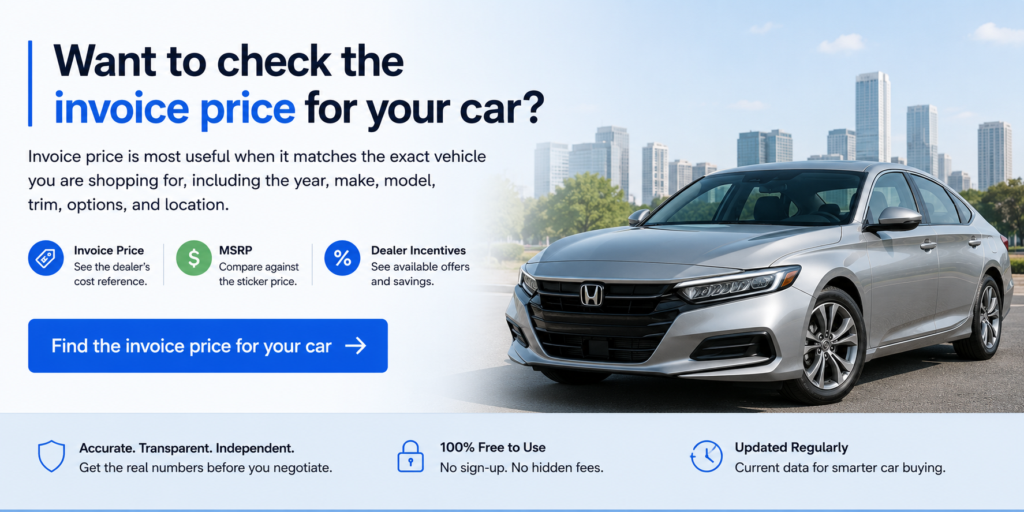
Finding invoice price on your own can be difficult because manufacturers and dealers do not always publish exact invoice pricing for every trim, option package, and region. A general estimate can help, but the most useful number is tied to the specific vehicle you are considering.
As a next step, use the Invoice Pricing form on this page or start a pricing request for the vehicle you want. The more specific the vehicle details are, the more useful the pricing context becomes.
Before you compare dealer offers
Know the invoice benchmark, then compare the final out-the-door number. This keeps you from being distracted by a big MSRP discount that may be weakened by fees, add-ons, or unclear incentives.
What Competitors Often Miss About Invoice Price
Many car-buying articles define invoice price and stop there. That leaves shoppers with a term, but not a decision framework.
Invoice is not always net cost.
Holdback, factory-to-dealer incentives, dealer cash, and volume bonuses can change what the dealer effectively has in the vehicle.
The final number still matters most.
A good invoice benchmark does not protect you if the out-the-door price includes inflated fees, mandatory add-ons, or unclear rebate treatment.
Frequently Asked Questions About Invoice Price
What does invoice price mean?
Invoice price means the amount listed on the invoice a manufacturer sends to a dealer for a new vehicle. For buyers, it is useful because it gives a pricing reference point below MSRP, but it should not be treated as the dealer’s final real cost or the final price you will pay.
Is invoice price the same as dealer invoice price?
In most car-buying conversations, yes. Invoice price and dealer invoice price usually refer to the manufacturer’s invoice amount assigned to the dealer for a new vehicle. The key point is that this number is a benchmark, not always the dealer’s final net cost.
Is invoice price the same as dealer cost?
Not always. Invoice price is the amount shown on the manufacturer’s invoice to the dealer, but the dealer’s real cost can be lower after incentives, holdback, dealer cash, volume bonuses, or other credits.
What is the difference between invoice price and MSRP?
MSRP is the manufacturer’s suggested retail price, usually shown on the window sticker. Invoice price is the amount listed on the invoice sent from the manufacturer to the dealer. MSRP helps you understand the suggested selling price, while invoice price helps you understand the dealer’s pricing reference point.
Does invoice price include taxes and fees?
No. Invoice price does not include taxes, title, registration, dealer documentation fees, or add-ons that may appear in your final offer. Those costs are part of the out-the-door price.
Can you buy a car below invoice price?
Sometimes. A dealer may be able to sell below invoice price when manufacturer incentives, dealer cash, inventory pressure, or sales goals make the deal worthwhile. This depends on the vehicle, market conditions, local demand, and available incentives.
How do I find the invoice price of a car?
To find the invoice price of a car, you need the exact year, make, model, trim, options, and location. A generic estimate may not match the specific vehicle you are comparing, which is why it is helpful to use an invoice pricing lookup process before negotiating.