
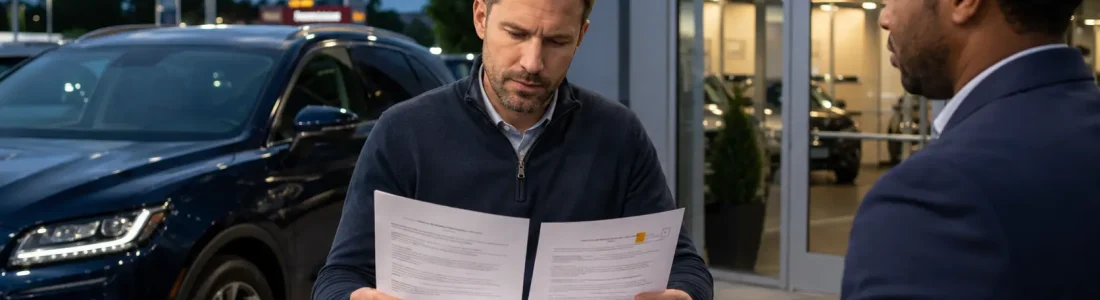
Before the vehicle moves
Determine whether the financing is truly final
Possession of the vehicle, temporary tags, insurance, a first-payment date, or a signed retail installment contract may not resolve every question if another document makes delivery conditional.
1. Ask the direct question
Is my financing final and approved by the named creditor, or am I taking conditional delivery while financing is still pending? Request the answer in writing.
2. Identify the creditor
Record the lender or assignee expected to own the contract, an application or approval reference, and the contact method you can independently verify.
3. Locate every conditional term
Read the retail installment contract, buyer’s order, bailment agreement, conditional-delivery agreement, addendum, and any document describing rejection or return.
4. List every remaining condition
Income verification, residence, insurance, stipulations, down payment, co-signer, lender interview, identity documents, or vehicle eligibility should not remain vague.
5. Ask what happens if assignment fails
Document the deadline, notice method, vehicle-return process, mileage or damage rules, down-payment refund, trade-in status, and whether either party may propose revised terms.
6. Keep a complete signed copy
Photograph or scan every page, including backs, attachments, filled blanks, disclosures, product agreements, receipts, and temporary-registration records.
Do not rely on verbal certainty
Statements such as ‘you are approved,’ ‘the bank just needs to finish paperwork,’ or ‘this is standard’ do not replace the written contract. If the documents conflict with the explanation, stop and ask for one clear written account before leaving.
Conditional delivery record
Spot-delivery worksheet
Complete this record while the people who represented the deal are available. Preserve names, dates, contract terms, and the condition of both vehicles.
Delivery and financing status
Protect the trade-in
Ask whether the trade may be sold, retitled, paid off, or otherwise transferred before financing is final. Record current mileage and condition, remove personal data, and retain the trade agreement, payoff quote, keys transferred, and value assigned.
Do not renegotiate under surprise
What to do if the dealership says financing was not approved
A call demanding an immediate return can create urgency. Slow the process, preserve the current contract, and obtain the claimed change in writing before deciding what to do.
1. Ask for written notice
Request the reason financing was not finalized, the date the dealer learned it, the contract provision being invoked, and the required next step.
2. Do not agree to new terms by phone
Ask for a complete written proposal showing creditor, APR, term, payment, amount financed, down payment, co-signer requirement, products, and every changed transaction term.
3. Compare with your signed documents
Review all conditional terms and use the buyer’s order checklist and finance-office checklist to identify what changed.
4. Contact the named lender through a verified channel
Ask what information the lender can confirm about the application or contract. Do not rely on a phone number supplied only in an unexpected message.
5. Account for money and both vehicles
Before any return or rewrite, request written treatment of the down payment, deposit, trade, payoff, mileage, insurance, temporary registration, and vehicle condition.
6. Get state-specific help when needed
Contract and motor-vehicle rules vary. Consider contacting your state attorney general, motor-vehicle regulator, consumer-protection agency, or qualified attorney before a disputed surrender or rewrite.
Do not hide, damage, or abandon the vehicle
Continue protecting and insuring the vehicle as required. This page is educational, not legal advice. If the dealer asserts a contractual return right or threatens repossession, obtain prompt state-specific advice rather than guessing.
Signs to slow down
Conditional-financing pressure signals
No single fact proves wrongdoing. The combination of unclear status, incomplete documents, escalating terms, and urgency is a reason to pause and independently verify.
No one will state approval status
Different employees give different answers, the named lender is missing, or a manager avoids putting final-versus-conditional status in writing.
You leave without every document
The dealership says copies will be mailed, signatures are missing, blanks remain, or a conditional-delivery document appears only after the transaction.
The return call rewrites the economics
The dealer requests more cash, a co-signer, a higher APR, a longer term, added products, a different vehicle, or a lost incentive.
Immediate action is demanded
You are told to return at once, sign remotely without review, disclose new sensitive data through an unverified channel, or decide before seeking help.
Your prior vehicle is no longer available
The trade is reportedly sold, paid off, transferred, or unavailable before the conditional financing issue is resolved.
The paperwork tells two stories
One document appears final while another gives the dealer broad cancellation or return authority, and no one explains how they operate together.
Before shopping
Reduce dependence on conditional dealer financing
You cannot eliminate every issue, but you can arrive with alternatives and insist on a documented transaction.
Bring outside financing
Use the dealer versus bank and credit-union worksheet to secure and compare an outside offer before the dealer controls the only financing path.
Shop while lenders are open
If possible, complete the transaction when the lender can verify approval and stipulations. Avoid allowing a closing-time deadline to replace document review.
Separate financing from OTD
Secure a written itemized out-the-door price before the financing structure changes. Recheck it after any revised approval.
Delay irreversible transfer
Ask whether the dealership can hold, pay off, sell, or transfer the trade before financing is final and whether your agreement restricts those actions.
Preserve the transaction immediately
Scan the complete signed set before leaving. Save the online listing, advertisements, messages, payment receipts, and condition photos.
Be willing to pause
If final financing cannot be confirmed and the conditional terms are unacceptable or unclear, consider postponing delivery until the transaction is complete.
Common questions
Spot delivery and yo-yo financing FAQs
Is every spot delivery a scam?
No. A dealership may legitimately deliver a vehicle while financing assignment is pending. Risk increases when the conditional status is unclear, documents are incomplete, or the buyer is pressured into worse replacement terms.
How do I know if my car financing is final?
Read every signed document, identify the creditor, ask whether approval and assignment are final, list any outstanding conditions, and request the answer in writing. Possession of the car alone does not settle the question.
Can a dealer ask me to return a car after signing?
Rights and obligations depend on the contract, financing status, facts, and state law. Request written notice identifying the contract term and obtain state-specific advice if the demand is disputed.
Do I have to sign a higher-rate loan if financing falls through?
Do not assume you must accept a new proposal. Request the complete new terms and compare them with the signed documents, conditional-delivery agreement, and applicable state law before deciding.
What happens to my down payment if financing is not approved?
The written agreement should address refund timing, deductions, and payment method. Preserve the receipt and request a written accounting before returning or rewriting the deal.
What happens to my trade-in during conditional delivery?
Ask before delivery whether the trade can be paid off, sold, transferred, or retitled while financing is pending. If a dispute arises, request a written status and state-specific guidance.
Where can I report a disputed dealership financing practice?
Depending on the issue and state, resources may include the state attorney general, state motor-vehicle or dealer regulator, consumer-protection agency, the FTC, CFPB, or a qualified attorney.