Chevrolet Bolt Review 2027: The Comeback of The Year

from the experts at Invoice Pricing

Cars Chevrolet Chevrolet Bolt Review 2027: The Comeback of The Year
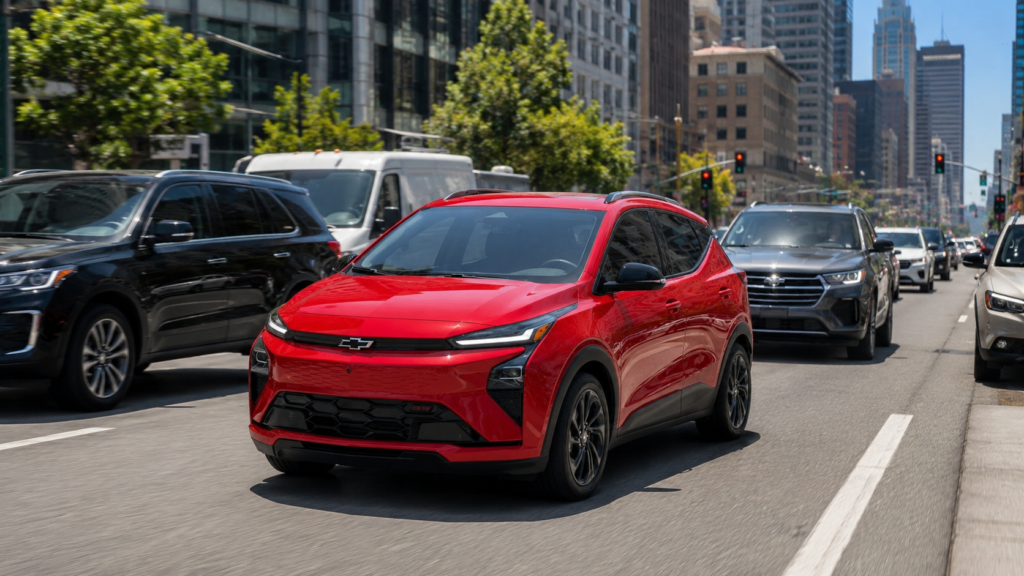
Red Chevrolet SUV driving in a busy city street, leading a line of cars during daytime traffic.

2027

Chevrolet

Bolt

The 2027 Chevrolet Bolt review that follows features a smaller, simpler, more focused vehicle aimed at a specific buyer: someone who wants reliable daily electric transportation at a price that actually makes sense without a federal tax credit doing the heavy lifting. Starting at $27,600 before destination for the LT, and $31,600 for the RS, the 2027 Bolt is one of the most straightforward EV purchasing decisions on the market.

The 2027 Chevrolet Bolt is a four-door subcompact hatchback that returned to sale in early 2026 after being discontinued following the 2023 model year. GM brought it back by popular demand, which is a rarer outcome in the automotive industry than the phrase suggests. Customers called, wrote, and posted until the company reversed course. The result is a second-generation Bolt that keeps what worked, fixes what didn’t, and adds two features the original genuinely needed: dramatically faster DC fast charging and the ability to power your home during an outage. At $27,600 it is not just a good deal for an EV. It is a good deal for any car.

For buyers considering the Equinox EV alongside this vehicle, our 2026 Chevrolet Equinox EV review covers that model in full. This review focuses exclusively on the 2027 Bolt.

What's New

The 2027 Bolt is a clean-sheet second-generation. The body style transitions from the original’s car-like hatchback profile to a slightly taller, more upright shape that reads as a compact crossover. The wheelbase stretches to 105 inches. The most significant mechanical improvement is DC fast charging, which jumps from the original’s 55-kilowatt ceiling to 150 kilowatts, making the Bolt genuinely practical for road trips in a way its predecessor never was. The charging port switches to the NACS standard, providing direct access to the Tesla Supercharger network without an adapter. Vehicle-to-Home bidirectional charging arrives as a new capability, allowing the Bolt to power home appliances and critical systems during outages at up to 9.6 kilowatts. The battery chemistry switches to lithium iron phosphate cells shared with the Equinox EV, which lower costs, improve longevity, and reduce thermal management concerns without sacrificing usable range. An RS trim joins the lineup for the first time, adding a sporty appearance package and premium interior materials.

Infotainment and Connectivity

Every 2027 Bolt comes standard with an 11.3-inch touchscreen running Google Built-In, including Google Maps with integrated charging-station routing, Google Assistant voice commands, and access to the Google Play app. An 11-inch digital driver information display is standard across both trims. USB data and charging ports, satellite radio, and 5G connectivity are standard. Wireless phone charging is available as an option on both trims. Like the rest of GM’s EV lineup, the Bolt does not support Apple CarPlay or Android Auto. At this price point, that is a more pointed objection than it would be on the Equinox EV or Silverado EV. A buyer paying $27,600 who routinely uses third-party apps via CarPlay should factor this in before making a purchase. The Google Built-In system handles navigation competently, but the absence of the broader CarPlay ecosystem is real.

Chevrolet Bolt Price and Invoice Pricing

2027 Chevrolet Bolt Starting Price

The 2027 Chevrolet Bolt starts at $27,600 MSRP for the LT. The RS starts at $31,600. Both trims share an identical powertrain, battery, and range. The choice between them comes down entirely to style preferences and desired interior comfort features. The LT is the correct choice for buyers who want maximum value and the lowest possible entry cost into a capable, well-featured electric vehicle. The RS is the correct choice for buyers who want the standard Evotex interior, ventilated seats, and a sportier exterior appearance.

What Changes the Final Chevrolet Bolt Price?

The LT and RS are both available with optional packages that meaningfully change the feature set and price. The Evotex Package on the LT adds heated seats and synthetic leather. The Technology Package on both trims adds blind-spot monitoring, rear cross-traffic alert, and a head-up display. The Comfort Package adds an eight-way power driver seat and wireless charging. The Super Cruise Package, available exclusively on the RS and requiring the Technology Package, adds hands-free highway driving capability. A panoramic sunroof is available as a standalone option on the RS. Beyond packages, the final price can also vary based on destination charges, dealer-installed accessories, and local inventory conditions. The 2027 Bolt is designated as a limited production run vehicle, which means availability may vary by region.

How Invoice Pricing Helps Chevrolet Bolt Shoppers

At $27,600 to $31,600 before packages, the Bolt’s value proposition is already exceptional. Knowing what the dealer paid for the specific trim and package combination you are considering gives you a grounded baseline before any negotiation, particularly important for a vehicle where optional packages can add $3,000 or more to the final price. Invoice pricing gives shoppers a dealer-side cost reference for the exact Bolt configuration they are evaluating, helping assess whether the offer on the table reflects the vehicle’s actual cost to the dealer. For more background, read our guide to What Is Invoice Price and How it Works in 2026.

Where to Check Chevrolet Bolt Invoice Pricing

Whether you are comparing the LT and RS or evaluating which optional packages make sense for your budget, our Dealer Invoice Price Lookup Guide explains how shoppers can research invoice pricing before speaking with dealers. You can also visit our Chevrolet page to explore the full lineup, then check invoice pricing for the exact 2027 Chevrolet Bolt configuration you are considering.

Both the LT and RS use an identical powertrain. The 2027 Bolt is powered by GM’s X76 electric drive unit, a single permanent-magnet motor producing 210 horsepower and 169 pound-feet of torque driving the front wheels through a single-speed reduction gear. There is no all-wheel drive option.

Performance is what a model like this should be. Accelerates confidently from a standstill with the immediate torque response characteristic of electric motors, and it feels more responsive in everyday city driving than its modest power output suggests. It is not a fast car by any objective measure and buyers who prioritize performance should look at the Blazer EV SS or pay the premium for a more powerful model. What the Bolt does deliver is smooth, quiet, linear acceleration that makes it genuinely pleasant to drive in daily use, which is what matters for a vehicle at this price point.

One-pedal driving is standard, allowing the driver to slow and stop by lifting off the accelerator in most conditions. The Bolt’s one-pedal calibration is well-tuned and easy to adapt to for most drivers within a week of regular use.

The 2027 Bolt delivers an estimated 255 miles of range from its 65-kilowatt-hour LFP battery. EPA certification was pending at time of research with some sources citing 255 and others 259 miles depending on configuration. Either figure is competitive for a vehicle at this price and sufficient for most daily commuting and weekly driving patterns with home charging.

The charging improvement is the most important upgrade in the 2027 Bolt’s story. The original’s 55-kilowatt DC fast charging ceiling was genuinely limiting and made longer trips unnecessarily stressful. At 150 kilowatts peak, the 2027 Bolt charges from 10 to 80 percent in approximately 26 minutes at a compatible station, which is fast enough to make a 20-minute coffee stop a meaningful charging event. That changes the practical calculus of ownership significantly.

Level 2 home charging is supported at up to 11.5 kilowatts through the standard NACS port. The NACS port provides direct access to the Tesla Supercharger network across more than 25,000 locations in the United States, which meaningfully reduces public charging anxiety compared to the CCS-equipped original.

Vehicle-to-Home bidirectional charging, supported at up to 9.6 kilowatts with a compatible home charger, allows the Bolt to serve as a backup power source during outages. This feature, previously exclusive to more expensive EVs, is a meaningful practical addition at this price point and is particularly valuable in regions prone to power interruptions.

Every 2027 Bolt comes standard with more than 20 safety and driver-assistance features, including automatic emergency braking, forward collision alert, lane departure warning, lane keep assist, following distance indicator, and a rear-vision camera. The standard suite is comprehensive for the price class. Blind-spot monitoring and rear cross-traffic alert are available as part of the optional Technology Package on both trims. Super Cruise, GM’s hands-free highway driving system, is available as an option on the RS through the Super Cruise Package, which requires the Technology Package.

The 2027 Bolt seats five and offers 16.2 cubic feet of cargo space behind the rear seats, expanding to 56.3 cubic feet with the seats folded. The tall roofline and upright seating position improve headroom meaningfully over the original and give the cabin a more open feel than the exterior dimensions suggest. Rear legroom measures 39.1 inches, which is adequate for most adults on typical commuting trips.

Front legroom measures 44.2 inches, and the driver’s seat position feels natural rather than compromised. The LT comes with cloth seating, a urethane flat-bottom steering wheel, and a six-way manual driver seat. The available Evotex Package on the LT adds synthetic leather seating, a wrapped steering wheel, and heated front seats. The RS comes standard with Evotex seating with red stitching, ventilated front seats, a heated steering wheel, and multi-color ambient lighting. Interior storage is practical for a subcompact with sufficient door pockets and console space for everyday use.

Pros

  • $27,600 Is a Genuine Bargain in the EV Segment. No other new electric vehicle with this feature set, this range, and this charging capability is available at this price point in the United States.
  • 150-Kilowatt DC Fast Charging Transforms Road Trip Practicality. Charging from 10 to 80 percent in 26 minutes is the most important improvement over the original Bolt. It changes a vehicle that was once impractical for longer trips into one that is legitimately usable.
  • Vehicle-to-Home Capability Is Rare at This Price. The ability to power your home at up to 9.6 kilowatts during an outage is a feature that typically costs far more in competing vehicles.
  • NACS Port Means Direct Supercharger Access. Over 25,000 Tesla Supercharger locations available without an adapter represents a charging infrastructure advantage most competitors cannot match.
  • 255 Miles of Range Covers Almost Every Daily Use Case. Combined with home charging, 255 miles is more than sufficient for the vast majority of buyers who drive fewer than 50 miles daily and charge overnight.

Cons

  • No Apple CarPlay or Android Auto. At $27,600, the absence of CarPlay and Android Auto is a harder objection to dismiss than at higher price points. Buyers who rely on third-party app ecosystems should weigh this carefully.
  • No All-Wheel Drive Option. The Bolt is front-wheel drive only. Buyers in snow-prone regions who want AWD must step up to the Equinox EV at a significantly higher price.
  • Limited Production Run. GM has confirmed the 2027 Bolt is a limited-run model with no guaranteed successor. Buyers who want long-term parts availability and dealer support should factor this into the ownership calculus.
  • 169 lb-ft of Torque Feels Modest Under Hard Acceleration. The Bolt is a commuter car, not a performance vehicle. Buyers expecting the instant torque rush of more powerful EVs will find it underwhelming above city speeds.

The 2027 Chevrolet Bolt makes the clearest value argument in the electric vehicle market. At $27,600, 150-kilowatt charging, 255 miles of range, Tesla Supercharger access, and the ability to power your home during an outage, it does more for less than anything else on sale. Before you configure any package or trim, get the invoice price for the exact 2027 Chevrolet Bolt you are considering so you know what the dealer paid before the conversation starts.

Should I Buy the 2027 Chevrolet Bolt LT or the Equinox EV?

These two vehicles serve different buyers. The Bolt LT at $27,600 is the right choice if you primarily need reliable, affordable daily electric transportation for one or two people, live in a mild climate, and charge at home overnight. The Equinox EV at $33,600 is the right choice if you need more passenger and cargo space, want AWD capability, or prioritize a higher-spec infotainment and feature set. The $6,000 gap between them is real money, and for many buyers, the Bolt LT delivers 90 percent of the Equinox EV’s practicality at a significantly lower cost. Before deciding, check the invoice price on both the Bolt configuration and the Equinox EV trim you are comparing. The dealer cost gap between the two may differ from the MSRP gap, and that spread helps you evaluate which vehicle offers the better negotiated price for your situation.

Written by Invoice Pricing

Sources Reviewed

Chevrolet USA
EPA / FuelEconomy.gov
IIHS

Disclosure

Invoice-Pricing.com may connect shoppers with participating dealers.

Select Your Vehicle and See
Secret Dealer Pricing

Takes less than 30 seconds, 100% FREE.

Buying Tips

Buyer negotiating a new car price while reviewing a printed dealer pricing document across the desk from a salesperson at a dealership office.

Negotiating a New Car Price: What To Do Before You Make an Offer

Learn how to prepare before you negotiate a new car, so every offer you make…

Learn More

Auto prices on a dealership window sticker showing MSRP, invoice price, dealer fees, and out-the-door price highlighted in yellow

How to Read Auto Prices Before You Negotiate

Auto prices are never one number. Learn what MSRP, invoice price, and out-the-door price mean…

Learn More

: A car buyer researching how CarsDirect works on a laptop before contacting a dealer.

How Does CarsDirect Work? All You Need to Know

CarsDirect is a solid starting point. Here is what it can and cannot tell you…

Learn More

Car buyer reviewing pricing data on a laptop inside a dealership showroom before negotiating a deal

CarEdge Review: Is the Data Strong Enough to Negotiate?

CarEdge review: solid pricing tool, but here’s what you still need to verify before signing…

Learn More

A car buyer researching how TrueCar works on a laptop, with car keys and notes on the desk

How Does TrueCar Work? How to Use It and What to Look Beyond

How does TrueCar work — and is it enough? Learn what it shows, what it…

Learn More

Woman standing beside a new SUV outside a dealership with an Invoice Pricing lookup screen in the background.

Costco Auto Program vs Invoice Pricing for 2026

Compare Costco Auto Program and Invoice Pricing to choose the best way to buy your…

Learn More

More Chevrolet Models

Content