Dodge Durango Review 2026: A Throwback With Top Tech

from the experts at Invoice Pricing

Cars Dodge Dodge Durango Review 2026: A Throwback With Top Tech
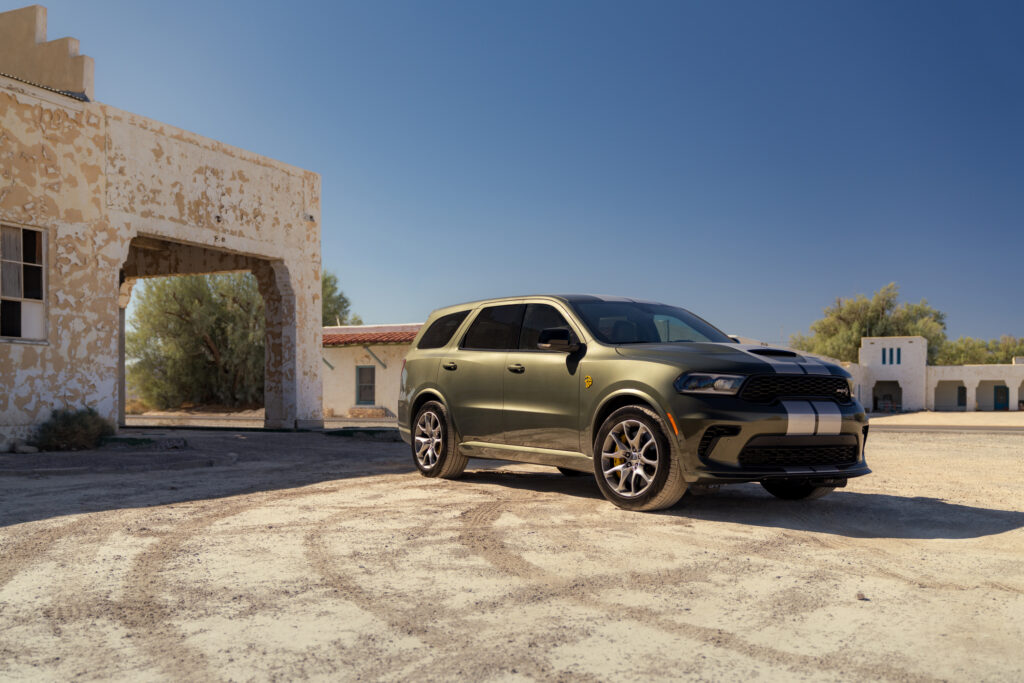
Green Dodge Durango parked in a desert-style setting near a stucco building, featured in our Dodge Durango Review.

2026

Dodge

Durango

In this Dodge Durango Review, we cover why, if you want a family SUV that blends muscle, modern tech, and old-school charm, the 2026 Dodge Durango is both a testament to durability and a reminder that not every update keeps pace with the times. “If it ain’t broke, don’t fix it” is what Dodge has done with the 2026 Durango, which is now in its second decade of production.

Although the company has improved the interior of this three-row SUV over the years, the current model features a 10.1-inch touchscreen and optional extras like air-conditioned front seats and high-end stereos, yet it still feels pretty old-fashioned.

A 3.6-liter naturally aspirated V-6 with rear-wheel drive is the smallest engine available. The Durango R/T models have a 360-hp V-8 engine if you need more power than 295 horsepower.

The range wouldn’t be complete without an SRT Hellcat version, but since the Durango is a Dodge, we’ll talk about that 710-hp supercharged beast on its own.

What's New?

For 2026, the Durango lineup shifts in a big way: Dodge drops the V6 and makes the Durango V8-only, with the GT moving to a 5.7-liter Hemi V8 and the R/T stepping up to the 6.4-liter 392 Hemi V8, while the Durango SRT Hellcat continues at the top and adds a Jailbreak option for more customization. Dodge also brings back the Blacktop Redline package on select trims, leaning harder into the Durango’s muscle-SUV identity rather than trying to modernize the platform.

Infotainment and Connectivity

For entertainment, the Durango features a 10.1-inch touchscreen with Bluetooth and WiFi connectivity, compatible with both Apple CarPlay and Android Auto. Audio options include a standard 6-speaker stereo, an available 10-speaker Alpine system, and an optional 20-speaker Harman/Kardon setup. The user-friendly Uconnect infotainment system operates through the 10.1-inch display and supports wireless Android Auto and Apple CarPlay. Bluetooth call quality is clear, with one driver noting that even the powerful rumble of the V-8 engine was audible during a call.

Price and How to Choose

Several models and options can affect the cost of the 2026 Dodge Durango. The tried-and-true V-6 engine, 20-inch wheels, a rear load-leveling suspension, front-seat ventilation, heated second-row seats, and other niceties make the GT Plus the right choice. For most families, the GT Plus stands out over the Citadel or R/T because it delivers the best mix of essential features and comfort for the price, giving you the most value without paying for upgrades you might not need.
The 2026 Durango offers a 3.6-liter V-6 with 295 horsepower and a 5.7-liter V-8 with 360 horsepower, both paired with an 8-speed automatic transmission. Buyers can choose rear-wheel drive (standard on the base GT) or all-wheel drive (available on all models for an extra cost).
For an extra $2,000, buyers can get all-wheel drive, but the base Durango GT is the only model with rear-wheel drive. The 295-hp V-6 engine and eight-speed automatic gearbox will work well for most casual drivers, but they won’t be very exciting. The R/T’s V-8 engine gives it a lot more speed and towing capacity, but it uses more gas.
The Durango is designed to look and feel like a powerful car, and its rear-wheel-drive system makes it fun to drive. Still, it’s a good SUV for families because it’s easy to live with and fun to drive, thanks to its suspension that isn’t too stiff.
Acceleration benchmarks are direct and easy to digest: with all-wheel drive, the Durango V-6 goes from 0 to 60 mph in 7.4 seconds, while the V-8 cuts that time down to 6.2 seconds.
We looked at the Durango more than ten years ago, and not much has changed since then. Both powertrains deliver a reliable blend of speed and capability, keeping the Durango competitive within its class.
  • In our fuel-economy test, the V-6 returned 22 mpg, while the V-8 R/T managed a surprising 23 mpg on the highway. Although the V-8’s results are better than its official EPA highway rating, this can happen at steady highway speeds, where the V-8’s low-rev cruising helps it exceed expectations despite generally consuming more fuel overall.
  • How the EPA rates cities: 14 to 18 mpg
  • The EPA says it gets 22-25 mpg on the highway.
The EPA hasn’t shared its estimates for the 2026 Dodge Durango’s gas mileage yet, but they should stay the same. The V-6 can get up to 18 mpg in the city and 25 mpg on the highway, while the V-8 can get up to 14 mpg in the city and 22 mpg on the highway. Here’s what the government says.
The 2020 Durango R/T with a V-8 engine surprised us by achieving 23 mpg on the highway, which was better than both the V-6 Durango’s 22 mpg and the EPA’s rating.
Many of the Durango’s safety features are optional, requiring an extra cost for the full suite. However, blind-spot monitoring and rear cross-traffic alert come standard. Buyers can also opt for additional safety technologies, such as adaptive cruise control and automatic emergency braking. For example, adding both adaptive cruise control and automatic emergency braking typically costs about $1,295 extra, which could make a real difference when you’re deciding on value for your family.

Cargo:

First Row:

This is comfy and well-designed, and the design fits Dodge’s signature style of combining luxury and muscle cars.

Second Row:

Some SUV competitors offer more space in the second row, but the Durator’s second row is suitable for adults. For the second row, most people use a bench with three seats, but you can also use a pair of captain’s chairs if you’d rather.

Third Row:

We like the high back because it makes a small area feel bigger. However, it’s harder to get into the third row because the bench in the second row doesn’t slide.

Cargo Space:

The Durango could fit 30 carry-on bags with all of the back seats folded down, but only four behind the third row. For easier cross-shopping, that translates to around 85 cubic feet of cargo space with both rear rows folded, and about 17 cubic feet of space behind the third row. This gives families a clear idea of how much luggage or gear they can load for road trips or weekly errands.

Towing:

Vehicles with a 3.6-liter V-6 engine can pull up to 6200 pounds. Vehicles with a 5.7-liter V-8 engine can pull up to 7200 pounds or 8700 pounds with the Tow and Go option.

Pros

  • Available V8 option (360 hp) if you want more power than the base V6.
  • Strong towing capability, with up to 6,200 lbs on the V6 and up to 8,700 lbs with the V8 and Tow and Go package.
  • Uconnect infotainment is described as user-friendly, with a standard 10.1-inch touchscreen and wireless smartphone integration.
  • Practical cargo volume in testing: 30 carry-on bags with the rear seats folded (but limited space behind the third row).
  • Blind-spot monitoring and rear cross-traffic alert are standard, with more driver-assist tech available.

Cons

  • The platform is old, and the SUV can feel dated even with newer screens and options.
  • The V6 is described as adequate but not exciting, and the V8 uses more fuel.
  • Many safety features are optional, so the “full suite” can add cost.
  • Third-row access is compromised because the second-row bench does not slide as easily.
  • Fuel economy is not yet published for 2026 in your draft, and is expected to carry over rather than improve.

If you are buying a Durango, the smartest move is to price the exact trim and package combo, not the name on the liftgate. Check invoice pricing through our form so you can see what a fair deal looks like on your specific build and keep dealer add-ons from quietly inflating the final number.

Is the 2026 Dodge Durango worth buying in 2026, and which version should I choose?

The Durango is worth it if you want a three-row SUV with muscle-car personality and serious towing ability, and you are okay with a design that is older than most rivals. For 2026, Dodge has announced a big lineup shift: the Durango moves to V8-only power, with the GT getting a 5.7-liter V8, the R/T stepping up to a 6.4-liter 392 V8, and the Hellcat staying at the top. Choose the GT if you want the most reasonable path into the Durango and you care more about daily comfort than maximum shove. Pick the R/T if you want the Durango to feel like the SUV it looks like, plus the stronger towing-focused attitude. If you are considering the Hellcat, treat it like its own category: it is about drama and straight-line speed first, family duty second. Also pay attention to availability. For 2026, some reports note the R/T and Hellcat cannot be sold in CARB states, while the 5.7-liter GT remains available nationwide. On features, plan your budget around safety tech because many advanced driver-assist items can be optioned rather than standard,

The 2026 Durango is not a small refresh. It is a lineup reset built around one headline decision: Dodge drops the V6 and goes V8-only across the range. That means the Durango GT now steps up to the 5.7-liter Hemi V8, and the Durango R/T switches to the 6.4-liter 392 Hemi V8, giving the mainstream trims a lot more muscle than before. At the top, the Durango SRT Hellcat returns again, and Dodge also offers a more customizable Hellcat Jailbreak version for buyers who want the full loud, over-the-top experience.

On the appearance side, Dodge brings back the Blacktop Redline package (with aggressive SRT-style design touches) and updates wheel choices, leaning into the Durango’s “muscle SUV” identity rather than trying to make it feel newer than it is.

depending on trim and package, and third-row access is still not as easy as it should be for a family SUV.

Select Your Vehicle and See
Secret Dealer Pricing

Takes less than 30 seconds, 100% FREE.

Buying Tips

Buyer negotiating a new car price while reviewing a printed dealer pricing document across the desk from a salesperson at a dealership office.

Negotiating a New Car Price: What To Do Before You Make an Offer

Learn how to prepare before you negotiate a new car, so every offer you make…

Learn More

Auto prices on a dealership window sticker showing MSRP, invoice price, dealer fees, and out-the-door price highlighted in yellow

How to Read Auto Prices Before You Negotiate

Auto prices are never one number. Learn what MSRP, invoice price, and out-the-door price mean…

Learn More

: A car buyer researching how CarsDirect works on a laptop before contacting a dealer.

How Does CarsDirect Work? All You Need to Know

CarsDirect is a solid starting point. Here is what it can and cannot tell you…

Learn More

Car buyer reviewing pricing data on a laptop inside a dealership showroom before negotiating a deal

CarEdge Review: Is the Data Strong Enough to Negotiate?

CarEdge review: solid pricing tool, but here’s what you still need to verify before signing…

Learn More

A car buyer researching how TrueCar works on a laptop, with car keys and notes on the desk

How Does TrueCar Work? How to Use It and What to Look Beyond

How does TrueCar work — and is it enough? Learn what it shows, what it…

Learn More

Woman standing beside a new SUV outside a dealership with an Invoice Pricing lookup screen in the background.

Costco Auto Program vs Invoice Pricing for 2026

Compare Costco Auto Program and Invoice Pricing to choose the best way to buy your…

Learn More

Popular Car Reviews

Content