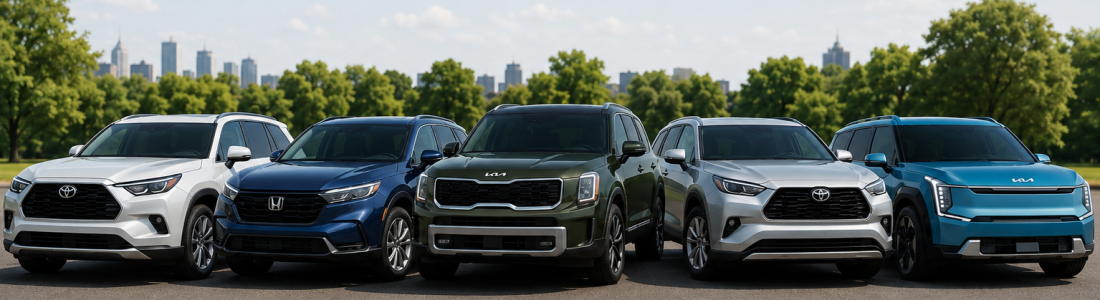
The most important factors to consider when choosing a family SUV are your family size, cargo needs, driving habits, powertrain fit, budget, safety rating, whether you truly need a third row, and the total purchase price, including taxes, fees, and add-ons.
Some households rely on compact SUVs for daily commutes, including school drop-offs. Others may need extra passenger room for carpools or road trips. Build an accurate shortlist first, then compare features, ownership costs, and pricing before buying.
Quick Picks: Best SUVs for Families by Need
Start here if you just want the short answer for your specific situation.
| Category | Recommended SUV | Why It Stands Out |
|---|---|---|
| Best Overall | Toyota Grand Highlander | Excellent mix of space, practicality, and efficiency |
| Best for Small Families | Honda CR-V | Easy daily driving and strong reliability |
| Best 3-Row SUV | Kia Telluride | Spacious and family-friendly |
| Best Hybrid SUV | Toyota Highlander Hybrid | Excellent efficiency without charging |
| Best Electric SUV | Kia EV9 | Spacious EV built with families in mind |
| Best Value SUV | Hyundai Tucson | Strong features for the price |
| Best for Road Trips | Chevrolet Traverse | Cargo room and highway comfort |
| Best for Safety/Visibility | Subaru Forester | Excellent visibility and driver confidence |
How to Choose the Best SUV for Your Family
The most important thing to understand is how the vehicle will actually be used day to day. Here is how the major choices compare.
2-Row vs. 3-Row
A third row is appealing, but it is not necessary for every family.
A 2-row SUV works well for:
- Easier parking
- Better fuel economy
- Simpler daily driving
- Lower cost
A 3-row SUV makes sense for:
- Large households
- Frequent carpooling
- Regularly carrying multiple passengers
Compact vs. Midsize vs. Large
A compact SUV suits smaller families who prioritize efficiency and maneuverability. A midsize SUV typically offers the best balance of passenger room and practicality. A large SUV maximizes space and long-distance comfort.
Gas vs. Hybrid vs. EV
A gas SUV suits families who travel long distances, prefer lower upfront complexity, and want wide fuel availability without charging.
A hybrid SUV suits families with frequent school runs and errands, with no change to refueling habits and strong city driving efficiency.
An EV suits families with home or public charging access, offering predictable daily mileage and sufficient range for household routines.
Best Overall SUV for Families
Toyota Grand Highlander
Best for: a family of 5-6. The Toyota Grand Highlander stands out for its spacious cabin, dedicated tablet slots, digital rearview mirror, and power outlets. It is well suited to long-distance vacations and errands with multiple people.
If you are interested in this vehicle, compare the MSRP to the invoice price before you head into negotiations. That gives you helpful context on pricing for your desired configuration and availability.
Pros
- Big cabin
- Ideal for road trips
- Hybrid options available
- Cargo room flexibility
Cons
- Large exterior size
- Expensive upper trims
Best SUV for Small Families That Do Not Need a Third Row
Honda CR-V
Best for: small households or families expecting their first child who prioritize fuel efficiency, ease of parking, and daily practicality over maximum passenger capacity.
Pros
- Easy to park
- Comfortable to drive
- Efficient powertrain option
- Strong reputation among current owners
Cons
- No third-row flexibility
- Smaller cargo area than larger SUVs
Best 3-Row SUV for Families
Kia Telluride
Best for: big families of 6-8 people. The Kia Telluride offers ample space for a large number of passengers, a strong interior, and features like a built-in Wi-Fi hotspot and smart device integration.
When researching this vehicle, pay close attention to the out-the-door price. That number matters because it includes taxes, fees, and add-ons that can meaningfully change the total.
Pros
- Room for a large number of passengers
- Well laid-out interior
- Good value relative to size
Cons
- Fuel economy trails hybrid competitors
- Higher trims become expensive quickly
Best Hybrid SUV for Families
Toyota Highlander Hybrid
Best for: a family that makes frequent school runs and has no interest in changing refueling habits. Hybrids sit between a combustion engine and an EV.
Pros
- Excellent MPG for a family SUV
- Quiet ride
- Good for long commutes
- No charging necessary
Cons
- Higher upfront pricing
- Limited availability in some trims
Best Electric SUV for Families
Kia EV9
Best for: parents who value safety features, a full driving range of 230 miles, and ample cargo space.
Pros
- Spacious seating
- Modern safety features
- Good cargo flexibility
- Family-friendly
Cons
- Higher upfront pricing
- Public charging availability varies by region
Best Affordable Family SUV
Hyundai Tucson
Best for: budget-conscious families who value a strong warranty and nice interior features. When researching pricing, pay close attention to dealer fees on the new SUV, since they alone can push a vehicle’s price above your budget.
Pros
- Strong warranty
- Comfortable interior
- Solid features
- Competitive pricing
Cons
- Smaller than midsize competitors
- Base trims are less premium
Best Family SUV for Road Trips and Cargo Space
Chevrolet Traverse
Best for: drivers who love long-distance trips, value a 5-star NHTSA rating, and need a lot of cargo space.
Pros
- Large cargo space
- Good for long-distance drives
- Roomy seating area
- Good third-row access
Cons
- Large overall footprint
- Lower fuel economy than hybrids
Family SUV Buying Checklist
Ask yourself these questions before you make the final decision.
- Do you really need a third row?
- How many car seats will you use regularly?
- Is fuel economy or cargo space more important?
- Will you drive mostly in cities or on the highway?
- Does the SUV fit into your garage?
- Did you include insurance, taxes, and dealer fees in your budget?
Before You Buy: Compare MSRP, Invoice Price, Fees, and Out-the-Door Price
Most people default to MSRP as their guiding number, but MSRP rarely reflects what you’ll actually pay after negotiations. It’s a helpful reference point, not the full picture.
1. Understand what invoice price is and why it matters
Invoice price is the dealer-cost benchmark below MSRP that helps you evaluate whether a quote is genuinely competitive.
2. Find the invoice price for each vehicle on your shortlist
Check it for the exact trim and options you plan to buy, not just the base model.
3. Check the out-the-door price
This is the number that includes taxes, title, registration, and fees, and it is the number that should decide the deal.
4. Compare dealer fees
Fees can vary meaningfully between dealers even for the same vehicle and configuration.
5. Get quotes
Collect written offers so you can compare selling price, incentives, and the full out-the-door total side by side.
FAQ: Best SUVs for Families
What is the best SUV for families?
The best SUV for families depends on your seating needs, budget, cargo space requirements, and driving habits. The Toyota Grand Highlander and Chevrolet Traverse are strong options for families who travel often. Once you’ve decided, check the invoice price and the out-the-door price and compare them before you negotiate.
What is the best family SUV with 3 rows?
Consider the Kia Telluride, Toyota Grand Highlander, and Hyundai Palisade. Which one fits best depends on how you’ll use the third row and how much cargo space you need. Research the invoice price and out-the-door price for each before deciding.
What is the best SUV for a family of four?
The Honda CR-V, Hyundai Tucson, and Toyota Highlander all offer enough passenger space and a comfortable driving experience for a family of four.
Is a hybrid SUV worth it for families?
If you’re constantly making school runs and running errands, a hybrid SUV is worth it. They offer strong fuel efficiency without requiring any change to your refueling habits.
Is an electric SUV good for families?
If you have reliable home charging, an electric SUV is a great option. They offer predictable daily range and a comfortable ride, which matters for families with young children.
Should I compare the MSRP or the invoice price before buying?
Compare both. They’re both useful reference points, but they explain different things. Understanding what out-the-door price, MSRP, and invoice price each mean, and how to compare them, is what lets you use them effectively.
Check Invoice Price Before You Negotiate
Get invoice pricing for your top vehicle picks, then compare it against MSRP, dealer fees, and the full out-the-door price before you head into negotiations.