Volkswagen Taos Review 2026: The Practical Case for Small

from the experts at Invoice Pricing

Cars Volkswagen Volkswagen Taos Review 2026: The Practical Case for Small
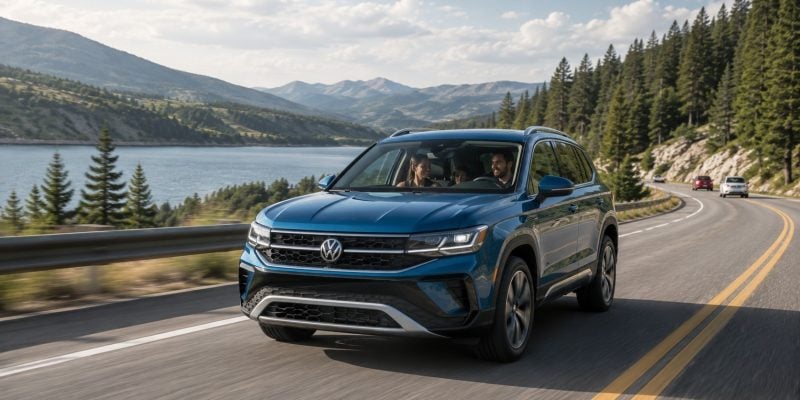
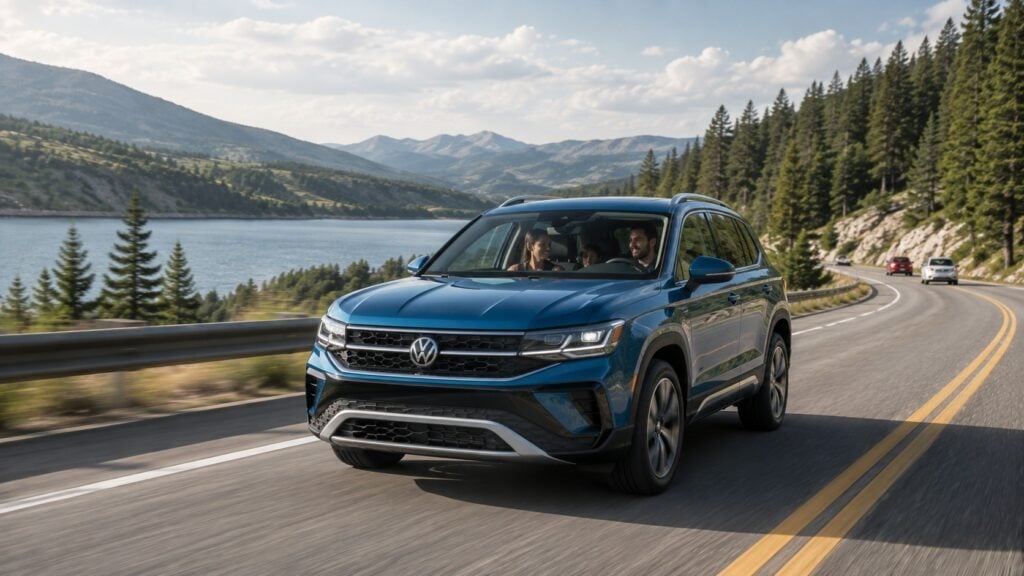
A blue 2026 Volkswagen Taos SUV drives along a mountain lake road with a smiling family visible inside, pine trees and mountains in the background.

2026

Volkswagen

Taos

The 2026 Volkswagen Taos returns as one of the more convincing arguments for buying a smaller SUV instead of talking yourself into a bigger one, and that argument is the subject of this Volkswagen Taos review. Slotting below the Tiguan in Volkswagen’s lineup, the Taos carries over the styling and powertrain updates from its 2025 refresh with only minor changes for the new model year, including standard rear-seat pretensioners, standard wireless App-Connect, and a mid-year bump to 15-watt wireless charging. Every Taos is powered by a turbocharged 1.5-liter four-cylinder making 174 horsepower, paired with an eight-speed automatic and available 4Motion all-wheel drive.

Four trims carry the 2026 lineup: S, SE, SE Black, and SEL, each available with front-wheel drive or 4Motion all-wheel drive. Pricing starts at $26,500 for the S FWD and climbs from there as buyers add all-wheel drive, the blacked-out SE Black treatment, or the fully loaded SEL. Volkswagen has also kept the safety story consistent across the board, since every Taos trim comes standard with the brand’s IQ.DRIVE suite of driver assistance features rather than reserving them for higher trims.

This review covers what changed for 2026, how the cabin technology stacks up, what the turbocharged engine and eight-speed automatic feel like day to day, EPA fuel economy by drivetrain, the safety equipment list, cargo and passenger space, and a full breakdown of Taos pricing and invoice cost so shoppers know what to expect before visiting a dealer.


What's New

Volkswagen kept the 2026 Taos largely the same as the heavily revised 2025 model, which already brought updated styling, a more powerful engine, and refreshed technology to the lineup. The most notable change for 2026 is that rear-seat pretensioners and wireless App-Connect, previously limited to higher trims, are now standard equipment across the entire lineup at launch. Volkswagen also confirmed a mid-model-year update that raises the wireless charging pad’s output to 15 watts, a meaningful bump for buyers who rely on wireless charging daily. SEL models pick up a new Volkswagen Premium Audio system with eight speakers, replacing the six-speaker setup that trim used previously. None of these changes are dramatic, but they close small gaps that previously made the entry-level Taos feel like an afterthought next to its pricier siblings.

Infotainment and Connectivity

Every 2026 Taos comes with an 8-inch floating touchscreen infotainment system, along with wireless App-Connect for Apple CarPlay and Android Auto and two USB-C ports offering 45-watt fast charging in the center stack. Stepping up to SE trim adds Composition Media with Voice Control, a three-month SiriusXM 360L trial, and wireless device charging, while SEL trim adds built-in navigation on top of everything SE offers. The Volkswagen Digital Cockpit instrument display is standard across the lineup, though the size and functionality differ by trim: S models get an 8-inch display with two view options, while SE and SEL models receive the more capable 10.25-inch Digital Cockpit Pro with up to four views, including a full-screen navigation map that mirrors the center display. Speaker count also scales with trim, from four speakers on the S to six on SE and SE Black, topping out at the new eight-speaker Volkswagen Premium Audio system on SEL.

Volkswagen Taos Price and Invoice Pricing

The 2026 Volkswagen Taos starts at an MSRP of $26,500 for the S FWD and $28,200 for the S 4Motion all-wheel-drive model, plus a $1,475 destination charge, according to Volkswagen. Four trims make up the lineup, S, SE, SE Black, and SEL, each offered with either front-wheel drive or 4Motion all-wheel drive. Trim level, drivetrain choice, and a handful of trim-specific option packages are what primarily separate the base price from the top of the range.

What Changes the Final Volkswagen Taos Price?

Moving up from the base S adds full keyless access, remote start, dual-zone climate control, heated front seats, and an 8-way power driver seat at the SE level, while SE Black adds blacked-out exterior styling and unique wheels for a similar price to SE. SEL sits at the top with leather seating, a panoramic sunroof, navigation, ventilated front seats, and the new eight-speaker premium audio system. Choosing 4Motion all-wheel drive over front-wheel drive adds cost at every trim level and slightly reduces EPA-estimated fuel economy in exchange for the added traction. Beyond trim, the final price can also vary based on destination charges, dealer-installed accessories, package availability, and local inventory conditions.

How Invoice Pricing Helps Volkswagen Taos Shoppers

Because the Taos spans a wide range of trims and drivetrain combinations, sticker prices at different dealerships can vary more than shoppers expect for what looks like the same configuration. Knowing the dealer-side cost reference for the specific S, SE, SE Black, or SEL configuration you want gives you a real number to negotiate from instead of guessing how much room a dealer has to work with. For a deeper explanation of how this works, see What Is Invoice Price and How It Works in 2026.

Where to Check Volkswagen Taos Invoice Pricing

Once you know which trim and drivetrain combination fits your budget, whether that’s a value-focused S FWD or a fully equipped SEL 4Motion, the next step is pulling the actual invoice figure for that configuration. Our Dealer Invoice Price Lookup Guide walks through that process step by step, and you can also browse current pricing across the rest of the lineup on the Volkswagen page.

Every 2026 Taos shares the same powertrain: a turbocharged 1.5-liter EA211 four-cylinder producing 174 horsepower and 184 pound-feet of torque, paired with an eight-speed automatic transmission with a Sport mode. That output is up from 158 horsepower in pre-refresh Taos models, a change that came from revised piston rings, updated fuel injectors, a modified turbo housing, a larger intercooler, and a new gasoline particulate filter. Front-wheel-drive models send power to the front axle only, while 4Motion models use Volkswagen’s latest all-wheel-drive system with Active Control, which offers Snow, On-Road, Off-Road, and Off-Road Custom drive modes along with a rotary control knob for tuning steering, throttle, and transmission behavior. The system is designed to preemptively distribute torque before wheelspin occurs rather than reacting after the fact, and it can send up to 50 percent of torque to the rear axle when conditions call for it. Ride quality favors comfort over sharpness, with a strut-type front suspension paired with a multilink rear on 4Motion models and a torsion beam rear on front-wheel-drive versions, which is typical for the class.

Volkswagen’s own EPA-estimated ratings put the front-wheel-drive 2026 Taos at 28 mpg city, 36 mpg highway, and 31 mpg combined. Choosing 4Motion all-wheel drive brings those figures down to 25 mpg city, 33 mpg highway, and 28 mpg combined, a larger gap between drivetrains than some rivals show. The engine’s use of a Miller-cycle valve timing strategy, where intake valves close earlier in the induction stroke, along with a high 11.5-to-1 compression ratio, helps the turbocharged engine return competitive combined fuel economy without giving up the power gains from the 2025 refresh. All ratings are based on regular unleaded fuel, and Volkswagen recommends checking FuelEconomy.gov for the most current figures before purchase.

Every 2026 Taos comes standard with Volkswagen’s IQ.DRIVE suite of driver assistance technology, regardless of trim. That includes Front Assist with Forward Collision Warning and Automatic Emergency Braking with pedestrian monitoring, Active Blind Spot Monitor, Rear Traffic Alert, Adaptive Cruise Control with Stop and Go, Lane Assist, Travel Assist for semi-automated highway driving, and Emergency Assist, which can bring the vehicle to a controlled stop if the driver becomes unresponsive. Six airbags, an Automatic Post-Collision Braking System, an Intelligent Crash Response System, and a standard rearview camera round out the passive and active safety equipment. Light Assist, which automatically manages high beams based on oncoming traffic, is standard on every trim, while Park Distance Control is standard starting at SE and Dynamic Road Sign Display is standard on SEL. Volkswagen backs the Taos with a four-year, 50,000-mile bumper-to-bumper warranty and a Carefree Maintenance program covering the first two scheduled services.

The 2026 Taos offers 99.5 cubic feet of total passenger space thanks to its relatively long wheelbase, with 40.1 inches of front legroom and 37.9 inches in the rear, both generous figures for a compact SUV. Front-wheel-drive models offer 27.9 cubic feet of cargo space behind the second row and 65.9 cubic feet with the second row folded flat, while 4Motion all-wheel-drive models trade some of that space for the drivetrain hardware, offering 24.9 cubic feet behind the second row and 60.2 cubic feet folded. Volkswagen does not publish a U.S. tow rating for the Taos, and towing with it is not manufacturer-approved, so shoppers who need to pull a trailer regularly should look at the Tiguan or Atlas instead.

Pros

  • Standard IQ.DRIVE on every trim. Even the base S gets Forward Collision Warning, Active Blind Spot Monitor, and Adaptive Cruise Control with Stop and Go, a rarity at this price point.
  • Roomy for its class. With 99.5 cubic feet of passenger space and up to 65.9 cubic feet of cargo room with the seats folded, the Taos punches above its compact-SUV footprint.
  • Stronger turbocharged engine. The 174-horsepower 1.5-liter engine, paired with an eight-speed automatic, delivers more usable power than several naturally aspirated rivals in the segment.
  • Available 4Motion with Active Control. Snow, On-Road, Off-Road, and Off-Road Custom drive modes give the Taos more all-weather flexibility than most competitors offer at this price.
  • Digital Cockpit Pro on SE and above. The configurable 10.25-inch instrument display and full-screen navigation view feel like a genuine tech upgrade over the base gauge cluster.

Cons

  • No towing capacity. Volkswagen does not publish a U.S. tow rating for the Taos, so buyers who need to haul even a small trailer will have to look at the Tiguan or Atlas instead.
  • Base S trim feels sparse. Four speakers, cloth-only upholstery, and the smaller 8-inch gauge cluster make the entry trim feel more like a starting point than a destination.
  • AWD costs real efficiency. Stepping up to 4Motion drops EPA-estimated combined fuel economy from 31 mpg to 28 mpg, a bigger gap than some rivals show between drivetrains.
  • Navigation and premium audio wait for SEL. Buyers who want built-in navigation or the new eight-speaker premium sound system have to reach the top trim to get either one.

The 2026 Taos backs up its tech and space advantages with pricing that rewards a little research before you commit. Before you sit down at the dealership, get the invoice price for the exact trim you are considering.

Is the 2026 Volkswagen Taos too small, or should I step up to the Tiguan?

The Taos makes sense for buyers who mostly carry two to four people and want a smaller footprint for parking and daily driving, while still getting 65.9 cubic feet of cargo room with the seats folded. The Tiguan adds more rear-seat space, a standard third-row option on some trims, and a tow rating the Taos doesn’t offer, but it also starts at a noticeably higher price. If your trips rarely call for a trailer or a third row, the Taos covers most of what the Tiguan does for less money, and checking invoice pricing on both models side by side is the fastest way to see whether the size upgrade is actually worth the price difference.

Written by Invoice Pricing

Sources Reviewed

Volkswagen USA
EPA / FuelEconomy.gov
IIHS

Disclosure

Invoice-Pricing.com may connect shoppers with participating dealers.

Select Your Vehicle and See
Secret Dealer Pricing

Takes less than 30 seconds, 100% FREE.

Buying Tips

Man in a green shirt typing on a laptop at a wooden desk by a window, with a plant and phone nearby.

Car Buying Email Templates: Ask a Dealer for the Out-the-Door Price

Copy email templates to request an itemized out-the-door price from dealers….

Learn More

Shopper comparing dealership inventory at the best time to buy a new car

Best Time to Buy a New Car in 2026: Timing Guide

See how model-year changeovers and incentive cycles affect the best time to buy in 2026….

Learn More

Monroney sticker vs. dealer addendum comparison on a new car window

Monroney Sticker vs. Dealer Addendum: The Full Guide

See which window sticker charges are factory-installed and which ones the dealer added….

Learn More

Car shopper comparing a cash rebate with another financing option

Cash Rebate vs. 0% APR Calculator: Which New Car Offer Saves More?

Compare cash rebates vs. 0% financing to see which offer saves you more….

Learn More

Destination charge listed on a new car window sticker

Destination Charge on a New Car: Is It Included?

See if a destination charge is already included in MSRP and dealer invoice price….

Learn More

Two professionals review a printed form together at a desk in a bright office, one holding a pen over the document.

New Car Incentives, Rebates, and Dealer Cash: What to Know

See how new car incentives, rebates, and dealer cash affect your final purchase price….

Learn More

More Volkswagen Models

Content